
-
Uddannelse
Find uddannelse
Studievejledning
Besøg AU
Kvalitet
- Forskning
-
Samarbejde
-
Om AU
Organisation
Kontakt
Kandidatuddannelse
| Fakta om uddannelsen Undervisningssprog: Engelsk (Se sprogkrav) | Studiested: Beijing | Studiestart: August / september (ingen vinterstart) |
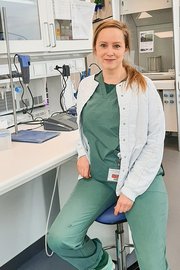
The biggest advantage to taking the Neuroscience and Neuroimaging programme is the natural interplay between the biological and the engineering aspects, which gives you a unique basis for building bridge between scientific fields, and if there is one thing that is needed, it is the ability to identify where technical research can help real people. The professors teach the fields that they are experts in themselves and you can pick their brains while they are in China as well as grab the opportunity to network. Besides that, living and studying in China was an incredible experience.
Giske Fiskarbekk Opheim, postdoc from NRU, Rigshospitalet and Neuroscience and Neuroimaging MSc graduate
Neuroscience is a fast expanding field of expert studies that encompass and combine other scientific fields from molecules to imaging and pushes the boundaries of science. In addition, neuroimaging is developing technologically and is becoming accessible throughout the world. The field has a great impact on the understanding, diagnosis and possible treatment of different devastating neurological diseases.
The interdisciplinary Master’s programme in Neuroscience and Neuroimaging is the first of its kind in Denmark and combines subjects from the Technical, Natural, and Life Sciences with the aim of producing graduates with state-of-the-art theoretical, technical, and clinical knowledge within neuroscience and neuroimaging. In particular, the broad approach to the field of neuroimaging, including the theory and engineering aspects underlying all cutting-edge image modalities is not offered as a master education anywhere else in Europe.
By uniting the expertise of Danish neuroscientist within basic, molecular, and clinical neuroscience and based neuroimaging (MR/PET/EEG/MEG) with Chinese scientists trained in advanced neurobiology, research tool development, and in the design of neuroimaging hardware, the study programme offers a unique educational environment not seen anywhere in the world. In addition, the study programme includes courses in basic neuroscience from the molecular level to the clinical setting describing the different neurological diseases, the treatment of as well as the study of these including animal models used in neuroscience and neuroimaging research.
The SDC Master’s programme in Neuroscience and Neuroimaging is developed by active researchers from both Denmark and China – uniting the most recent research, modern technology, and problem-oriented learning methods. This programme is based in China.
The unique combination of advanced imaging techniques and a broad knowledge in basic and clinical neuroscience topics enables the students to join the growing field of neuroscience and neuroimaging as well as fill the rising demand for graduates specialized in neuroimaging due to the increasing worldwide availability of high-resolution scanners.
Through the inclusion of top researchers as guest lectures, the students will be introduced to the latest advances in neuroscience research and techniques.
You will obtain knowledge in:
Graduates will have a unique education and cross-cultural insight. They will be obvious candidates for industrial R & D positions, academic research and/or clinical positions at neuro-oriented hospital departments or join neuroscience PhD schools at universities in Denmark and abroad. Currently almost three-quarters of graduates from this programme are enrolled in or have graduated a PhD programme. The MSc degree programme in Neuroscience and Neuroimaging targets students who would like to combine Neuroscience and modern advanced technology to create the new technologies and forms of therapy that will help the growing number of patients with brain disorders.
On completion of the programme, you receive a double degree and the following titles: Master of Science in Neuroscience and Neuroimaging from Aarhus University and Master of Neurobiology/Biophysics from the University of Chinese Academy of Sciences.
Admittance to the MSc programme in Neuroscience and Neuroimaging is based on:
Eligible bachelor’s degrees to the MSc programme in Neuroscience and Neuroimaging include:
The programme admits a maximum of 15 students each year.
According to national legislation in China, Chinese citizens cannot apply for admission to Neuroscience & Neuroimaging through a Danish university. Instead, Chinese Citizens must apply for admission through University of Chinese Academy of Sciences.
Students must be above average in at least one of the following categories:
In evaluating qualified applicants, the admissions committee assesses each applicant on the basis of the following criteria:
The assessment is based on the supplied documented information and can, thus, not include marks/grades obtained after application deadline
General English language requirements ('English B level' - Danish upper secondary school level)
The application deadline for the Master’s degree programme in Neuroscience and Neuroimaging is 1 March for all applicants.
1.
The first semester is designed to give students, all of whom have different academic backgrounds, the necessary basic knowledge and competencies to follow the tailored courses in the rest of the programme.
The final course of the semester introduces several different imaging techniques. You take the following courses:
• Basic Neuroscience (10 ECTS)
• Introduction to Scientific Computing (2 ECST)
• Fundamental Biomedical Signal Processing (8 ECTS)
• Medical Neuroimaging (10 ECTS)
2.
In the second semester, more advanced courses build on the knowledge gained through the first semester courses. Some of the courses integrate both neuroimaging and neuroscience. You take the following courses:
• Human Brain Electrophysiology (5 ECTS)
• Neuroscience in a Clinical Perspective (5 ECTS)
• Preclinical Methods in Neuroscience (7.5 ECTS)
• Machine Learning in Neuroscience and Integrative Neuroimaging (7.5 ECTS)
• Specialisation/Elective Course (5 ECTS)
- Cognitive Science
- Advanced Neuroscience
- Advanced Magnetic Resonance Imaging
3.
In the third semester, you work on your Master’s thesis (60 ECTS) at a laboratory in China. While working on your Master’s thesis, you have a unique opportunity to work with state-of-the-art equipment and laboratories in China.
4.
The Master’s thesis is completed during the fourth semester.
Please note: Courses may be subject to change.
House of the Danish Industry Foundation
The teaching of the SDC Master’s programmes takes place at the Yanqihu Campus in Huairou District, 60 km northeast of Tiananmen Square in Beijing. The Yanqihu Campus offers indoor and outdoor sport facilities, canteens, restaurants, supermarkets and a location close to picturesque mountains and only 25km away from the Great Wall of China.
The SDC building has been donated by the Danish Industry Foundation. It houses auditoriums, reading facilities, class rooms, working facilities for academic faculty, administrative facilities, housing facilities for researchers and common areas.
You find SDC on